
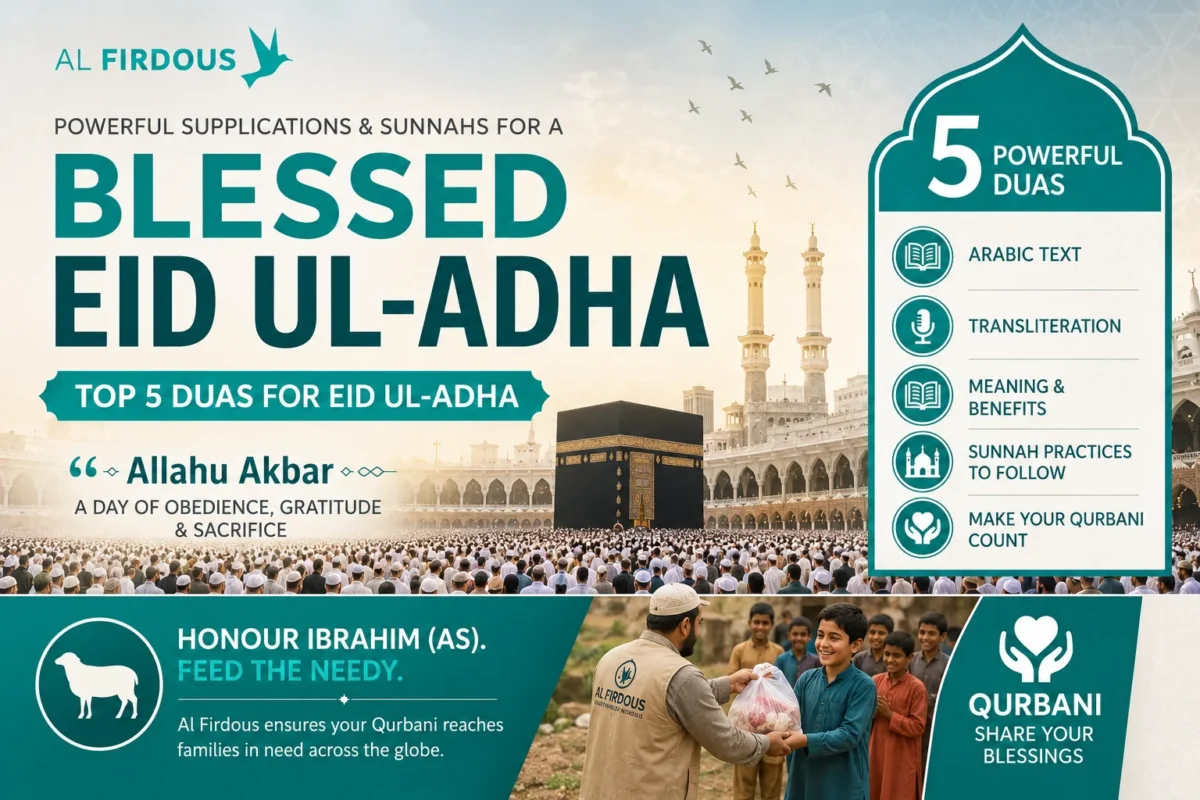
Imagine standing shoulder to shoulder with millions of Muslims across the globe, all raising their voices in unison with the words “Allahu Akbar” — what dua will you carry in your heart on that sacred morning? Eid ul-Adha is not merely a celebration; it is a profound spiritual milestone that marks obedience, gratitude, and the timeless legacy of Prophet Ibrahim (AS). Every year, Muslims worldwide honour this occasion with heartfelt supplications, sacred rituals, and the act of Qurbani that feeds families in need. Yet many of us rush through the day without pausing to learn the essential duas for Eid ul-Adha that can transform our worship. In this comprehensive guide, we share the top 5 duas for Eid ul-Adha along with key Sunnah practices to help you make the most of this blessed day.
Whether you are preparing for your first Eid prayer or simply looking to deepen your connection with Allah (SWT), this blog will serve as your go-to resource. We have carefully compiled each dua with its Arabic text, transliteration, and meaning so you can recite with confidence and understanding. Read on to discover how these powerful supplications and Sunnah acts can elevate your Eid ul-Adha experience — and learn how your sacrifice can reach those who need it most through Al Firdous Organisation.

Al Firdous ensures your Qurbani reaches families in need across the globe.
What Is Eid ul-Adha and Why Is It Important?
Eid ul-Adha, often called the “Festival of Sacrifice,” falls on the 10th of Dhul Hijjah and commemorates Prophet Ibrahim’s (AS) willingness to sacrifice his son in obedience to Allah’s command. It is one of the two major Islamic holidays and holds deep spiritual significance for every Muslim. The day is marked by congregational prayers, the giving of Qurbani, and a spirit of generosity that extends to neighbours, relatives, and the less fortunate. Families gather to share meals prepared from the sacrificial meat, embodying the Islamic values of compassion and community. For Muslims in the UK and beyond, it is an opportunity to reconnect with faith and serve those in need of food and support.
Beyond the festive atmosphere, Eid ul-Adha carries a powerful reminder about submission to Allah (SWT) and trust in His wisdom. The duas recited throughout the day are not mere formalities — they are sincere conversations with the Creator, seeking His acceptance, forgiveness, and blessings. Understanding and reciting the correct duas for Eid ul-Adha with intention can make the difference between routine observance and truly transformative worship.
Top 5 Duas for Eid ul-Adha
اللهُ أَكْبَرُ اللهُ أَكْبَرُ لَا إِلٰهَ إِلَّا اللهُ وَاللهُ أَكْبَرُ اللهُ أَكْبَرُ وَلِلّٰهِ الْحَمْدُ
“Allahu Akbar, Allahu Akbar, La ilaha illallah, Wallahu Akbar, Allahu Akbar, Wa lillahil Hamd”
(Allah is the Greatest, Allah is the Greatest. There is no god but Allah. Allah is the Greatest, Allah is the Greatest, and all praise belongs to Allah.)
The Takbirat of Eid is the defining supplication of the entire Dhul Hijjah season. Muslims begin reciting the Takbir at-Tashriq after Fajr on the 9th of Dhul Hijjah and continue through Asr on the 13th, filling homes, mosques, and streets with the declaration of Allah’s greatness. It is recommended to recite it aloud on the way to the Eid prayer ground, during transitions between activities, and after every obligatory Salah. This collective proclamation unites the Ummah in a shared expression of devotion. The spiritual energy of hearing the Takbirat echoing across your community is truly unmatched.
Reciting the Takbirat is a Sunnah that carries immense reward and serves as a constant reminder that Allah (SWT) is above all things. Whether you are walking to the mosque or preparing the Eid meal at home, keeping this dua on your tongue throughout the days of Tashreeq transforms every moment into an act of worship.
بِسْمِ اللهِ وَاللهُ أَكْبَرُ اللّٰهُمَّ تَقَبَّلْ مِنِّي
“Bismillāhi Wallāhu Akbar. Allāhumma Taqabbal Minnī”
(In the Name of Allah, Allah is the Greatest. O Allah, accept this from me.)
The dua for Qurbani is recited at the moment of sacrifice and connects the physical act to its spiritual purpose. It is a declaration that the sacrifice is being made solely for the pleasure of Allah (SWT), following the noble example of Prophet Ibrahim (AS). When you say “Allāhumma taqabbal minnī”, you are asking the Creator to accept your offering — not just the animal, but the sincerity behind it. This dua reminds us that Qurbani is never about the blood or the meat reaching Allah; rather, it is our taqwa (God-consciousness) that reaches Him. If you are donating your Qurbani through Al Firdous, your intention and this dua still carry full spiritual weight.
For those unable to perform the sacrifice themselves, organisations like Al Firdous carry out the Qurbani on your behalf and distribute the meat to vulnerable communities across Bangladesh, Pakistan, Gaza, and beyond. Making this dua sincerely — whether at home or at the point of donation — ensures your worship is complete and accepted, In Sha Allah.
رَبَّنَا تَقَبَّلْ مِنَّا إِنَّكَ أَنْتَ السَّمِيعُ الْعَلِيمُ
“Rabbana taqabbal minna, innaka antas-Samī’ul-‘Alīm”
(Our Lord! Accept from us. Indeed, You are the All-Hearing, the All-Knowing.) — Surah Al-Baqarah, 2:127
This beautiful Quranic supplication was made by Prophet Ibrahim (AS) and his son Ismail (AS) while they were building the Ka’bah — the holiest site in Islam. Reciting it on Eid ul-Adha creates a direct spiritual link to the very legacy this day celebrates. It is a dua of humility, acknowledging that no matter how grand our worship, only Allah decides whether to accept it. The phrase “Antas-Samī’ul-‘Alīm” affirms that Allah hears every whisper and knows every intention in our hearts. Incorporating this dua into your Eid worship adds depth and sincerity to the entire experience.
Many scholars recommend reciting this supplication after completing your Eid prayer, after giving charity, and after the Qurbani. It is a versatile and powerful dua that pairs beautifully with any good deed, reminding us to remain humble no matter how much we give or sacrifice.

Spreading joy — Al Firdous Eid Gift Packs bring smiles to children in need.
الْحَمْدُ لِلّٰهِ عَلَىٰ مَا هَدَانَا
“Alhamdu lillāhi ‘alā mā hadānā”
(All praise be to Allah for He has guided us.)
Gratitude is at the heart of every Islamic observance, and Eid ul-Adha is no exception. This dua acknowledges that every blessing we enjoy — health, family, faith, and the ability to perform Qurbani — is a gift from Allah (SWT) alone. Reciting it after Eid Salah or during family gatherings sets the tone for a day centred on thankfulness rather than material indulgence. Scholars remind us that expressing shukr (gratitude) is itself a form of worship that draws us closer to Allah. The more grateful we are, the more Allah promises to increase His blessings upon us.
On a practical level, this dua can be woven into your entire Eid routine. Say it as you put on your best clothes, as you greet loved ones, and as you share the Qurbani meat with neighbours and those less fortunate. Let gratitude be the thread that ties every moment of your Eid ul-Adha together.
تَقَبَّلَ اللهُ مِنَّا وَمِنْكُمْ
“Taqabbalallāhu minnā wa minkum”
(May Allah accept from us and from you.)
This is the traditional Eid greeting exchanged between Muslims, and it is far more than a pleasantry. By saying “Taqabbalallāhu minnā wa minkum,” you are making a dua for your fellow Muslim — praying that their fasting, prayers, Qurbani, and every act of worship during Dhul Hijjah is accepted by Allah. It is a reciprocal supplication that strengthens bonds within the community and reflects the collective spirit of Islam. When you say this greeting to your family, neighbours, and friends, you are actively participating in an exchange of blessings. This simple yet profound phrase captures the essence of Eid ul-Adha perfectly.
Share this greeting generously — in person, over the phone, and on social media. The more you spread it, the more dua you receive in return, as every person you greet will likely say it back to you. It is one of the most beautiful aspects of Muslim community life.
Essential Sunnah Practices for Eid ul-Adha
Following the Sunnah of the Prophet Muhammad (SAW) on Eid ul-Adha elevates your day from a cultural celebration to a complete act of worship. These practices have been preserved through authentic narrations and are recommended for every Muslim to observe.
| Sunnah Practice | Details |
|---|---|
| Ghusl (Full Bath) | Perform a complete ritual bath before heading to the Eid prayer. Cleanliness is a sign of respect for the occasion. |
| Delay Eating | Unlike Eid ul-Fitr, the Sunnah on Eid ul-Adha is to delay eating until after the prayer — ideally from the meat of your own sacrifice. |
| Best Clothing | Wear your finest garments and apply fragrance. Present yourself well as you gather with the community. |
| Walk to Prayer | Walk to the Eid prayer ground if possible, and take a different route on the way back — following the Prophet’s (SAW) practice. |
| Takbirat at-Tashreeq | Recite the Takbirat aloud from Fajr on 9th Dhul Hijjah to Asr on the 13th, after every obligatory prayer. |
| Perform Qurbani | Carry out or donate your Qurbani after the Eid prayer. Distribute the meat to family, friends, and the poor. |
| Connect & Give | Visit family, exchange gifts, and give generously. Consider Eid Gift Packs for those in need. |
Each of these Sunnah acts carries its own reward and, when combined, turns your entire Eid day into an unbroken chain of worship. The key is intention — approach every practice with the awareness that you are following the beloved Prophet Muhammad (SAW) and seeking the pleasure of Allah (SWT).

Al Firdous supporting local communities in Leicester and across the UK.
Frequently Asked Questions
What is the best dua to recite on Eid ul-Adha?
The most important supplication is the Takbirat of Eid — “Allahu Akbar, Allahu Akbar, La ilaha illallah…” — which should be recited from the 9th to the 13th of Dhul Hijjah. Additionally, the dua for Qurbani and the Quranic supplication from Surah Al-Baqarah (2:127) are highly recommended to complete your worship on this blessed day.
When should I start reciting Takbir for Eid ul-Adha?
The Takbir at-Tashreeq begins after the Fajr prayer on the 9th of Dhul Hijjah (the Day of Arafah) and continues after every obligatory prayer until Asr on the 13th of Dhul Hijjah. It is Sunnah to recite it aloud, especially on the way to the Eid prayer ground.
Can I recite the Qurbani dua if someone else is performing the sacrifice on my behalf?
Yes, absolutely. If you have donated your Qurbani to an organisation like Al Firdous, you can still recite the dua “Bismillāhi Wallāhu Akbar, Allāhumma taqabbal minnī” at the time the sacrifice is expected to be carried out. Your intention and supplication count fully, regardless of who physically performs the act.
Should I eat before the Eid ul-Adha prayer?
The Sunnah on Eid ul-Adha is to delay eating until after the Eid prayer, and ideally the first thing you eat should be from the meat of your Qurbani. This differs from Eid ul-Fitr, where the Prophet (SAW) would eat dates before going out to the prayer.
How can I make my Qurbani count for those in need?
You can donate your Qurbani through trusted organisations such as Al Firdous, which distributes fresh meat to vulnerable families in Pakistan, Bangladesh, Gaza, and other regions. Visit the Qurbani/Udhiya page to arrange your sacrifice and ensure it reaches those who need it most. Al Firdous operates a 100% donation policy, meaning every penny goes directly to those in need.
Make Your Qurbani Count This Eid
Al Firdous Organisation delivers your sacrifice to the most vulnerable families across the world — with a 100% donation policy. Give your Qurbani today and let your worship bring relief to those in need.
Donate Your Qurbani NowMay Allah (SWT) accept your sacrifices, prayers, and good deeds.