
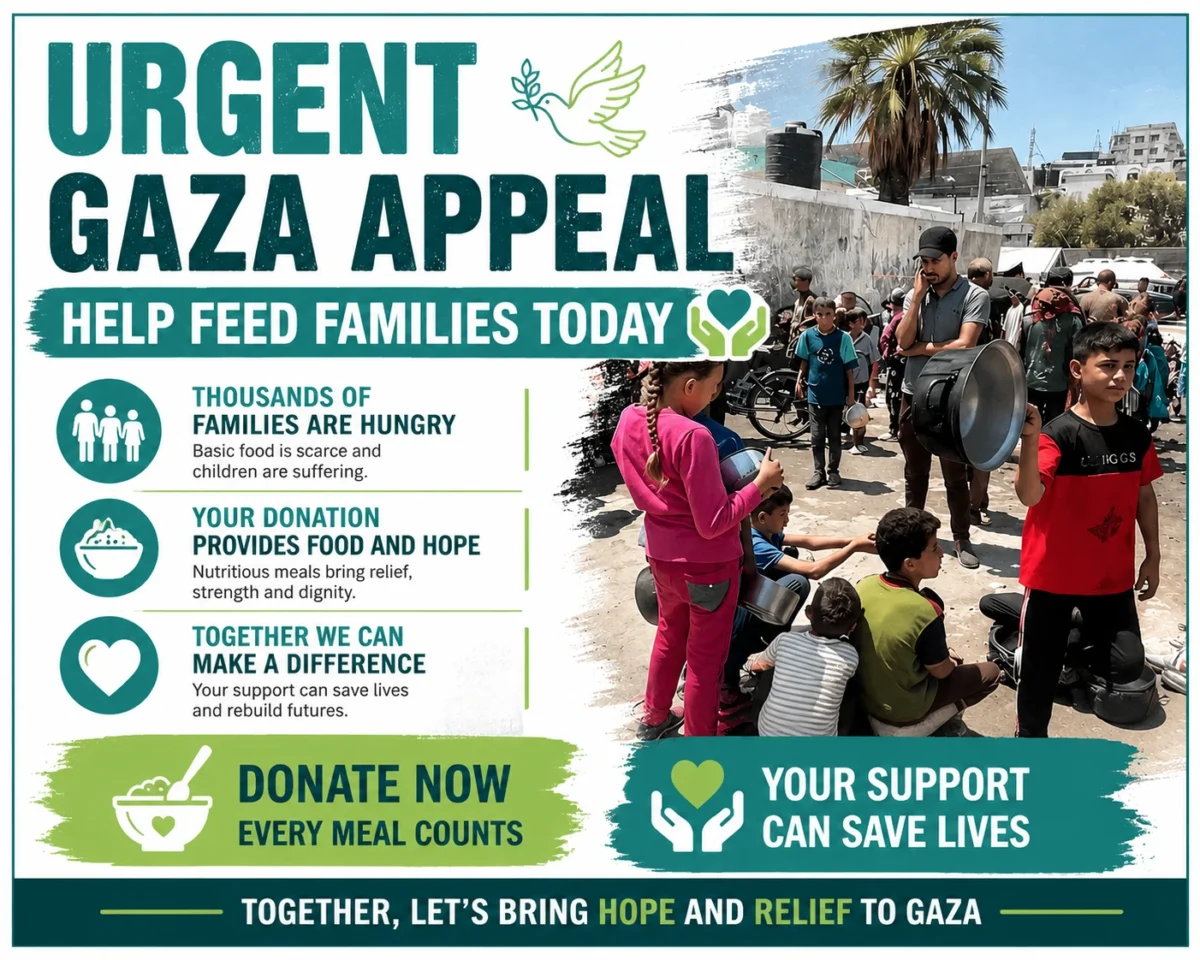
1. The Scale of the Gaza Crisis in 2026
The humanitarian situation in Gaza is one of the most severe in the world today. Years of conflict, a near-total blockade of aid, and the systematic destruction of infrastructure have pushed families to the very edge of survival. Despite a ceasefire announced in October 2025, the crisis has not ended — it has deepened in new and devastating ways.
The Integrated Food Security Phase Classification (IPC) — the leading international authority on hunger crises — has confirmed that Gaza meets the conditions for famine. Al-Firdous UK is on the ground, but the need far outstrips what any single charity can provide alone. Your support is urgently needed.
Food Insecurity & Famine
The numbers are stark. 1.6 million people — 77% of Gaza’s entire population — are facing high levels of acute food insecurity as of early 2026, according to IPC data. This includes:
Sources: IPC Acute Food Insecurity Classification, December 2025 — April 2026; WFP Palestine Emergency Report; OCHA Humanitarian Situation Report, April 2026.
The IPC confirmed that the three thresholds for famine — extreme food deprivation, acute malnutrition, and starvation-related deaths — have all been breached. The WFP describes the food situation in Gaza as “dangerously fragile,” warning that even the limited gains from the ceasefire could be reversed without sustained support.
The food available to most families consists largely of bread and processed foods high in sugar and salt. Dairy, eggs, meat, fish, and fresh fruit and vegetables are largely absent from local markets. This is not just hunger — it is severe and sustained malnutrition that is reshaping an entire generation.
Children & Malnutrition
The impact on children is catastrophic. According to Save the Children and WFP analysis:
| Group | Situation | Source |
|---|---|---|
| Children (all ages) | 4 in 5 children entered 2026 still facing crisis-level hunger | Save the Children / IPC, Dec 2025 |
| Infants under 6 months | 25,000 expected to suffer acute malnutrition in 2026 | IPC / Statista, Jan 2026 |
| Children aged 6–59 months | 101,000 cases of acute malnutrition expected in 2026 | IPC / UNOCHA, 2026 |
| Children aged 5–17 years | 120,000 cases of acute malnutrition expected in 2026 | IPC / UNOCHA, 2026 |
| Children at risk of death | 43,400 at severe risk of death from malnutrition by mid-2026 — tripled since May 2025 | WFP Famine Confirmation Report |
| Newborns | 1 in 5 babies born prematurely or underweight | WFP, 2025–2026 |
| Pregnant & breastfeeding women | 55,000 expected to suffer perilous malnutrition by mid-2026 — tripled since May 2025 | WFP Famine Confirmation Report |
Long-term damage is already happening
Save the Children warns that the little food available — bread and processed items — is causing irreversible harm: stunted growth, impaired cognitive development, compromised immune systems, and higher susceptibility to chronic illness in children who survive. Every minute of delay costs a child’s future.
Clean Water Collapse
Gaza’s water crisis compounds the food crisis in a deadly cycle. With over 80 groundwater wells destroyed, major desalination plants damaged, and 93% of liveable households experiencing water insecurity, the situation is dire.
Waterborne illnesses now make up 44% of all healthcare consultations. Skin diseases including scabies, lice, and impetigo are widespread. Families go days without water for bathing or washing. On average, more than 110 children aged 6 months to 5 years are admitted for malnutrition treatment every single day — with unsafe water a direct driver of this crisis.
In April 2026, OCHA reported that two UNICEF contractors were killed while delivering drinking water in northern Gaza, prompting the suspension of operations at a key water filling point.
Healthcare System Destruction
Gaza’s medical infrastructure has been devastated. According to WHO and Statista data as of early 2026:
Sources: WHO, Vatican News (May 2026); OHCHR; Palestinian Ministry of Health; Statista Gaza Infrastructure Report, Feb 2026.
None of the remaining functional facilities operates at full capacity. Medical supplies including vaccines, refrigerated medicines, and hygiene products continue to face restrictions and delays at border crossings. Rehabilitation services have lost two-thirds of existing capacity. Only 8 prosthetists serve the entire Gaza Strip.
Displacement & Shelter
Since the ceasefire announcement in October 2025, more than 730,000 people have been displaced, many living in makeshift shelters with no access to basic sanitation. UNICEF reports that around 800,000 children are displaced — desperately seeking safety in densely packed shelters where a single toilet serves 150 people and a single shower unit serves 700.
Overall, 81% of all structures in Gaza have been destroyed or damaged, including 92% of the housing stock, 77% of roads, and 66% of commercial and industrial facilities. Rebuilding will take decades. But families need food and clean water today.
2. Why Giving Now Matters
There is a common misconception that once a ceasefire is declared, the crisis eases. In Gaza, the opposite is true. The ceasefire has allowed limited aid in — but the damage, displacement, and destruction of infrastructure means that millions of families remain entirely dependent on external humanitarian support, with no means to feed themselves.
The Islamic obligation to give
The Prophet (PBUH) said: “The believer’s shade on the Day of Resurrection will be their charity.” (Tirmidhi). Giving Sadaqah to those in active crisis — especially during the blessed days of the Islamic calendar — carries immense reward. Your donation to the Gaza appeal is Zakat-eligible and fulfils a direct obligation of care for the Ummah.
The WFP warns that the fragile gains since the ceasefire could be reversed at any moment. Supply chains remain unstable. Aid workers are at risk — two UNICEF water contractors were killed in April 2026 while doing their jobs. The window to act is now, not later.
Giving through an established UK charity like Al-Firdous UK means your donation is handled with full accountability, reaches trusted on-the-ground partners, and supports families who would otherwise receive nothing.
3. How Al-Firdous UK Helps Gaza
Al-Firdous UK is a Leicester-based British Muslim charity (Registered No. 1207010) delivering humanitarian aid across eight countries. In Gaza, Al-Firdous works through trusted local partners to deliver food packs, clean water, and essential supplies directly to the families who need them most.
Emergency Food Packs
Monthly food packs containing rice, lentils, flour, cooking oil, and essential staples. Bulk purchasing keeps costs down and maximises the impact of every pound donated.
Clean Water Delivery
With 80+ groundwater wells destroyed and desalination plants damaged, Al-Firdous supports clean water distribution to displaced families in areas with no functional water supply.
Medical & Emergency Aid
Essential medical supplies, hygiene kits, and emergency aid to families living without access to functional healthcare in the aftermath of widespread hospital destruction.
Displaced Family Support
Aid for the 730,000+ people displaced since the ceasefire, living in makeshift shelters with no access to sanitation, clean water, or reliable food sources.
Child Nutrition Support
Targeted nutrition support for the most vulnerable — including infants, young children, and pregnant and breastfeeding women — who face the highest risk of malnutrition.
Qurbani Distribution
During Eid ul Adha, Al-Firdous distributes Qurbani meat in Gaza, providing many families with the only protein they will receive throughout the year.
100% commitment to impact
Al-Firdous UK purchases food in bulk from trusted wholesalers, pack by hand in safe facilities, and distribute directly to recipients — ensuring your donation goes as far as possible and reaches the most vulnerable families.
Every pound you give feeds a family
The families of Gaza cannot wait. They are surviving on bread and contaminated water. Your donation today means a child eats tomorrow.
4. Watch: Urgent Gaza Appeal
This video from Al-Firdous UK shows the reality on the ground in Gaza — and what your donation is able to achieve through the charity’s work with local partners.
Al-Firdous UK Urgent Gaza Appeal — Help Feed Families Today
5. What Your Donation Provides
Every donation, no matter the size, makes a direct difference to a family in Gaza. Here is a breakdown of what different amounts achieve on the ground:
| Donation Amount | What It Provides |
|---|---|
| £10 | Emergency food supplies — rice, lentils, and cooking oil for a family for several days |
| £25 | A week’s worth of essential food staples for a displaced family of four |
| £50 | A full emergency food pack containing rice, lentils, flour, and cooking oil for a family |
| £75 | Therapeutic nutrition packs or hygiene items with disinfectant, bandages, and essential medicines |
| £100 | A monthly food pack for a family, plus clean water contribution |
| £500 | Food and water aid for multiple families, plus a contribution to medical supply costs |
Figures are programme-level estimates. Actual contents vary with access, prices, and supply constraints. Al-Firdous allocates funds to the most urgent needs on the ground.
Is my donation Zakat-eligible?
Yes. Donations to the Gaza emergency appeal through Al-Firdous UK are Zakat-eligible. Zakat is allocated strictly per Islamic policy and is not used to cover administration beyond permissible limits. UK taxpayers can also add Gift Aid to increase the value of every donation by 25% at no extra cost.
6. Al-Firdous UK’s Wider Humanitarian Work
Gaza is one of eight places where Al-Firdous UK delivers aid. Every region faces its own crisis — and your support extends far beyond a single appeal.
Al-Firdous also delivers food packs and Qurbani across all of these regions. Every programme runs with the same commitment: direct delivery, trusted partners, and maximum impact from every donation.
7. How You Can Help Right Now
The families of Gaza need help today — not next week, not next month. Here are the most direct ways to make a difference:
- Donate to the Gaza Emergency Appeal — Give directly through Al-Firdous UK. Every pound is allocated to food, water, and essential supplies for families on the ground.
- Give a food pack — Donate a monthly food pack for a displaced family. This provides rice, lentils, flour, and oil — the basics no family should be without.
- Give your Qurbani to Gaza — Donate Qurbani through Al-Firdous UK and your sacrifice will feed a family in Gaza who would otherwise go without meat entirely.
- Give Zakat or Sadaqah — Gaza families are among the most deserving recipients of Zakat in the world right now. Donations are fully Zakat-eligible and Gift Aid can be added for UK taxpayers.
- Share the appeal — Tell your family, friends, and community about the crisis in Gaza. Share this page. Share the video. Awareness leads to action.
- Make dua — The people of Gaza have not been forgotten. Keep them in your prayers, especially during the blessed days of Dhul-Hijjah and the month of Ramadan.
8. Frequently Asked Questions
How bad is the food crisis in Gaza right now?
Extremely severe. According to IPC data from early 2026, 1.6 million people — 77% of Gaza’s population — face acute food insecurity. This includes 571,000 in Emergency (IPC Phase 4) and around 1,900 in Catastrophe (IPC Phase 5). An estimated 43,400 children face risk of death from malnutrition by mid-2026, a figure that tripled between May and late 2025. The WFP and IPC have both confirmed famine conditions in parts of Gaza.
Is famine confirmed in Gaza?
Yes. The IPC and WFP confirmed famine conditions in Gaza. Famine is classified when three thresholds are breached: extreme food deprivation, acute malnutrition, and starvation-related deaths. All three have been confirmed in Gaza by international humanitarian bodies. The WFP described conditions before the October 2025 ceasefire as “hell on earth.”
Has the ceasefire fixed the crisis?
No. The October 2025 ceasefire allowed limited improvements in some aid delivery, but as of April–June 2026, 77% of Gaza’s population remains food insecure, 81% of structures are still destroyed, and ongoing strikes continue to cause civilian harm. The WFP warns the fragile gains could be reversed at any point. The humanitarian crisis is ongoing and urgent.
How does Al-Firdous UK deliver aid to Gaza?
Al-Firdous UK works through trusted on-the-ground partners in Gaza to deliver emergency food packs, clean water, and essential supplies. They bulk-purchase food from trusted wholesalers to maximise each donation, pack it carefully in safe facilities, and distribute directly to the most vulnerable families — including those in makeshift shelters with no other source of food.
What does my donation to the Gaza appeal provide?
Donations fund emergency food packs (rice, lentils, flour, cooking oil), clean water delivery to areas with no functioning water supply, medical aid and hygiene supplies, and targeted nutrition support for children and pregnant women. £50 provides a full food pack for a family. £100 covers monthly food and water contribution for one household.
Is my Gaza donation Zakat-eligible?
Yes. Donations to Al-Firdous UK’s Gaza emergency appeal are fully Zakat-eligible. Zakat is allocated strictly per Islamic policy. UK taxpayers can also add Gift Aid, which increases the value of every pound donated by 25% at no extra cost to the donor.
What is the current state of Gaza’s hospitals?
As of early 2026, around 47% of Gaza’s hospitals remain partially functional, but none operates at full capacity. The WHO documented 22 attacks on hospitals and healthcare centres in just the first months of 2026. 1,722 healthcare workers have been killed (Palestinian Ministry of Health data, September 2025). Severe shortages of medicines, oxygen, and specialist equipment persist.
How can I give Qurbani to families in Gaza?
You can donate your Qurbani through Al-Firdous UK’s Qurbani programme. Al-Firdous arranges the sacrifice in full compliance with Islamic requirements and distributes the meat directly to families in Gaza and other countries where the need is greatest. Demand is high — book early as allocations fill quickly.