
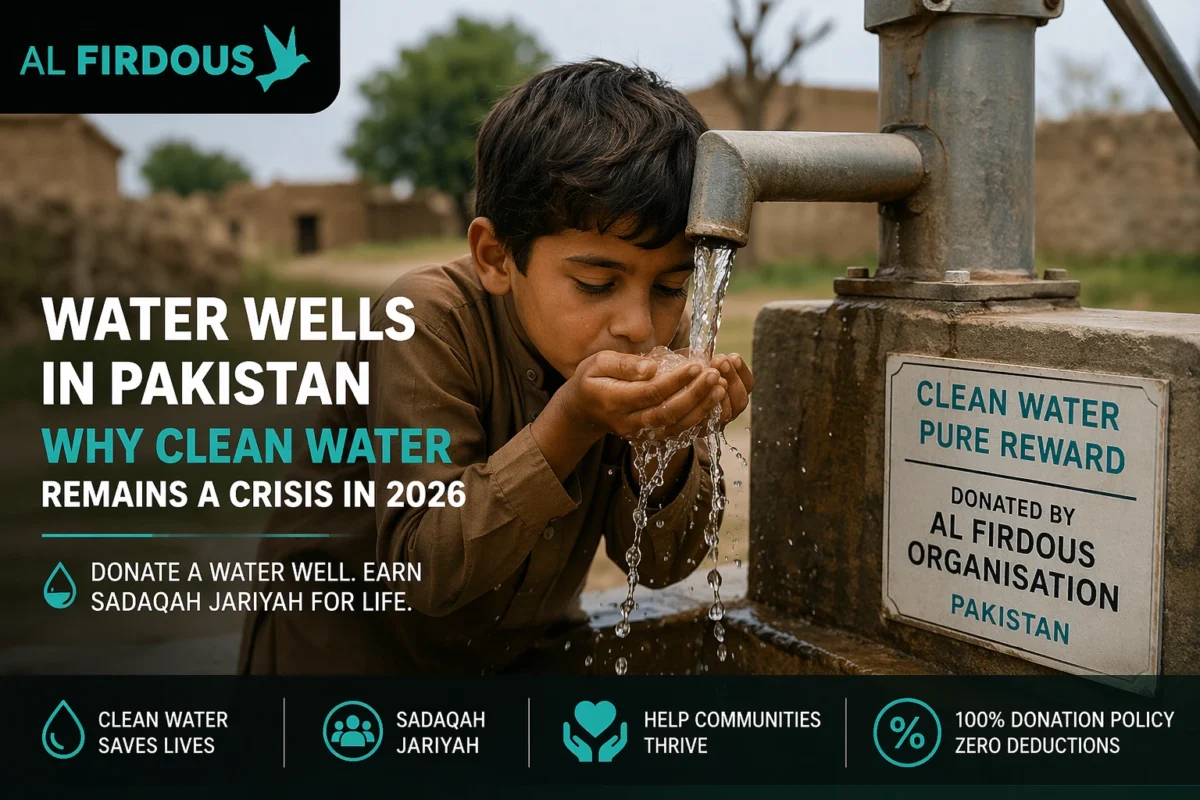
What if the water your child drank today could kill them tomorrow?
For millions of families across Pakistan, that is not a hypothetical question it is the reality they face every single morning. Right now, as you read this, children are walking hours to collect water that is contaminated with bacteria, arsenic, and disease. When you donate a water well in Pakistan, you are not just giving a gift — you are giving a life. You are planting a deed that will bear fruit long after you are gone. The Prophet Muhammad (SAW) said: “The best form of charity is giving water.” (Ibn Majah). If ever there was a moment for UK Muslims to act on that guidance, it is 2026 — because the water crisis in Pakistan is not improving. It is deepening.
What Is a Water Well Donation in Islam?
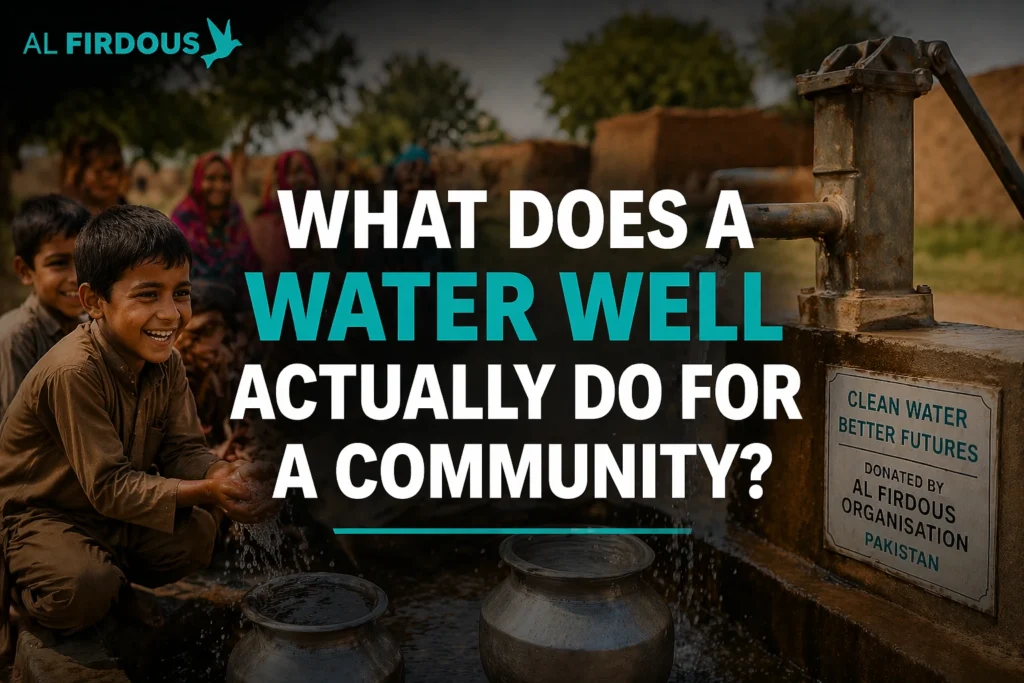
A water well donation is one of the most powerful forms of Sadaqah Jariyah ongoing charity in the entire Islamic tradition. Sadaqah Jariyah refers to a charitable act whose reward continues flowing to the giver even after death, for as long as the benefit reaches people. Few acts fulfil that definition as completely as providing a community with a permanent source of clean water.
Allah (SWT) says in the Quran:
“And We made from water every living thing.” — Quran, Surah Al-Anbiya, 21:30
Water is not simply a resource in Islam — it is a divine gift, and withholding it from people or failing to provide it when we have the means to do so carries serious moral weight. When you donate a water well in Pakistan, you are acting on one of the most direct commandments in Islamic ethics: to give people what they need to survive, to worship, and to live with dignity. Every person who drinks from that well, every family that uses it to cook a meal, every child who washes their hands before school each of them becomes a continuation of your charity.
Why Is Clean Water Still a Crisis in Pakistan in 2026?

Pakistan is the fifth most populous country in the world, yet access to clean, safe drinking water remains catastrophically limited for millions of its citizens — particularly those living in rural and flood-affected regions. Despite years of international aid and government promises, the structural causes of Pakistan’s water crisis remain largely unresolved in 2026.
The scale of the problem:
- Over 40 million Pakistanis lack access to clean drinking water, according to UNICEF estimates
- Groundwater in many regions — particularly Sindh and parts of Punjab — is contaminated with arsenic at dangerous levels, causing chronic illness, liver damage, and cancer
- Pakistan experienced catastrophic flooding in recent years that destroyed thousands of water sources, wells, and sanitation systems in rural communities
- Women and girls in affected areas walk an average of 3–5 kilometres per day just to collect water — time stolen from education, rest, and family
- Waterborne diseases including cholera, typhoid, and diarrhoea remain leading causes of child mortality in rural Pakistan
The people most affected are the ones least able to help themselves: widows with young children, elderly residents with no family support, orphaned children in villages where the nearest government water point is hours away on foot. For these communities, a single hand pump or covered water well installed by a UK Islamic charity can change the trajectory of an entire generation.
What Does a Water Well Actually Do for a Community?
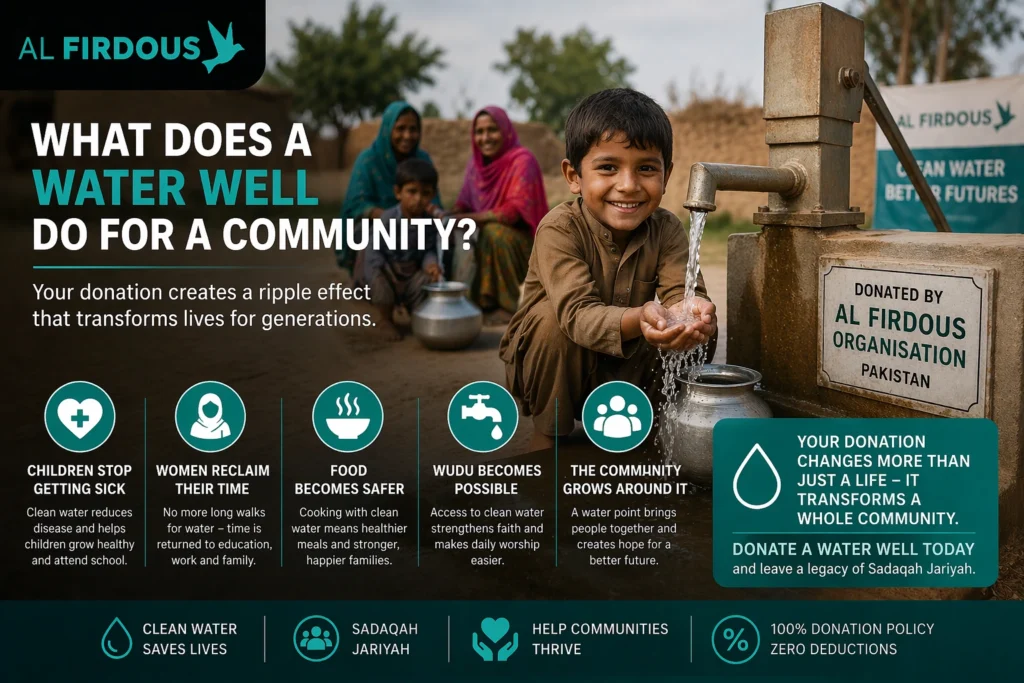
This is the question that matters most — not just the statistics, but the real, daily change that clean water brings to a family in Pakistan.
When a community receives a clean water source through a charity like Al Firdous, the ripple effects are immediate and lasting:
- Children stop getting sick. Waterborne illnesses that previously kept children out of school for weeks at a time are dramatically reduced. School attendance rises. The cycle of poverty begins to break.
- Women reclaim their time. Hours previously spent fetching water are redirected to earning, learning, and caring for their families. In rural Pakistan, this is transformative.
- Food becomes safer. Families cook with clean water, which reduces the contamination of food that causes so much preventable illness.
- Wudu becomes possible. For many rural Pakistani Muslims, consistent access to clean water means being able to maintain ritual purity — something that directly affects their ability to pray five times daily with ease.
- The community grows around it. A water point becomes a gathering place, a symbol of care and solidarity, and a reminder that someone far away — a Muslim in the UK — remembered them.
Al Firdous donors have already helped install water sources across rural Pakistan, including in communities devastated by flooding. Explore our Pakistan work here.
How Al Firdous Helps You Donate a Water Well in Pakistan
At Al Firdous Organisation, we have been delivering clean water projects in Pakistan alongside our wider humanitarian work — supporting communities affected by poverty, flooding, and displacement across the country.
What makes donating through Al Firdous different is our 100% donation policy: every single penny you give goes directly to the project. Not a fraction to overheads. Not a portion to administration. Every pound reaches the ground.
When you choose to donate a water well in Pakistan through Al Firdous, our team works with trusted local partners to identify the communities in greatest need, install durable and appropriate water solutions — from hand pumps to covered wells — and ensure that the infrastructure is maintained so your Sadaqah Jariyah keeps flowing for years to come.
This is your opportunity to leave something behind that matters. Something that outlasts you.
Donate to our Water Project today →
Your Drop of Kindness Travels Further Than You Think
Somewhere in rural Pakistan, a mother is carrying water in a worn-out container, walking back to her children under the midday sun. She does not know your name. But your charity can change her life — and the lives of every child who comes after her — for decades to come.
Al Firdous Organisation makes it simple, transparent, and meaningful to give. With our 100% donation policy, your money does not stop at an office door — it goes straight to the ground, into the earth, and up through a clean water pump that will serve a community for years.
Donate today atalfirdous.org.ukand let your good deed never end.
FAQs
How much does it cost to donate a water well in Pakistan?
The cost of a water well or hand pump in Pakistan varies depending on the depth, location, and type of installation needed. Al Firdous assesses each community individually to ensure the most appropriate and cost-effective solution is used. Contact us at info@alfirdous.org.uk for current pricing and project availability.
Is donating a water well considered Sadaqah Jariyah?
Yes — donating a water well is one of the most widely recognised forms of Sadaqah Jariyah in Islamic scholarship. The Prophet Muhammad (SAW) specifically mentioned giving water as a charity whose reward continues. Every person who benefits from the well extends your ongoing reward, including after your passing.
Can I donate a water well on behalf of a deceased parent or loved one?
Absolutely. Donating a water well in the name of a deceased parent, spouse, or relative is a deeply beloved act in Islam. The reward flows to both you and the person you dedicate it to. Many Al Firdous donors choose this as a memorial for a loved one they have lost.
How do I know my donation has been used correctly?
Al Firdous operates under UK charity law and is registered with the Charity Commission (No. 1207010). We maintain full transparency with donors and provide updates on project delivery. Our 100% donation policy means your money goes directly to the water project, not to administrative costs.
Why is clean water still a problem in Pakistan in 2026?
Despite years of development efforts, Pakistan’s water crisis persists due to a combination of flood damage, groundwater contamination — particularly from arsenic in Sindh and Punjab — rapid population growth, and inadequate rural infrastructure. Millions of families, especially in remote areas, still rely on unsafe sources for their daily water needs.
Al Firdous Organisation | 127 Bridge Road, Leicester LE5 3QP | Registered Charity No. 1207010 info@alfirdous.org.uk | +44 (0) 739 239 0104 | alfirdous.org.uk